
It is too easy for a Palestinian to claim Zionism is by nature an oppressive, genocidal, and aggressive ideology. That is not how I will begin my text. The Palestinian conversation has been, since conception, held back by demagogic slogans and romantic nationalist language. This has allowed for diffusion of ideas, but with no implementation to follow suit. Today we are equipped with access to knowledge and a privileged diaspora; a combination we have never had before. The combination of the two means there is no longer any excuse not to revise our narrative in a scientific and productive manner. Only once that happens, may we ever see hope of solving our people’s misery. This can only begin with an understanding of what Zionism is. The story must begin with Zionism.
Political Zionism has its roots in the writings of two influential Jews from very different circumstances: Leon Pinsker and Theodor Herzl. Different people, yet they agreed on certain subjects: the Jews consisted of a distinct and one people, and the assimilation of these people would never solve the social issue of antisemitism. Through this lens, Zionism can be seen as an admirable movement taking the fate of a people’s future, in their own hands. It is a national movement aiming to unify the Jews under one state. “We are what the Ghetto made us”1, said Herzl, and “legal emancipation is not social emancipation, and with proclamation of the former, the Jews are still far from being emancipated from their exceptional position”2, said Pinsker.
Both Herzl and Pinsker published their views at a similar time in The Jewish State (1896) and Auto-Emancipation (1882), respectively. This was a time of emancipation for the Jews of Western Europe. Following centuries of persecution, the Jews of Germany, France, the UK, were getting their full political rights. Zionism was birthed on the idea that even with full political rights, the Jews will still be seen as Jews within their societies. Despite freedom of movement, centuries of ghettoisation meant many will remain there and not reach full emancipation because they have been forced by their societies to be Jews on the outside of society. Herzl’s believed that integration was doomed and the only path to true emancipation is by building a state where the Jews govern themselves as a majority. This idea makes sense when you look at other emancipation movements; systemic discrimination can still exist in a context of full political rights, as is the case with Black Americans today. This separationist idea is not exclusive to Zionism and is a common feature in many nationalist independence movements. Pinsker and the early Zionists did not claim to invent something new, saying “what [they] seek is at bottom neither new nor dangerous to anyone”3.
So, what is Zionism at face value? It is the belief that Jews constitute a one, distinct people wherever they are, and that they will remain persecuted as long as they are not unified and self-governing. This utopic Zionism does not pose much of a threat to anyone, if taken in isolation. The moral issues begin in implementation. If this hypothetical Jewish state was built on a land uninhabited by anyone, who would have had an issue today? The systemically antisemitic European states would be happy that the Jews have left their countries, and the humanists would be happy that an oppressed group has successfully evaded oppression once and for all. If that was simply the case, I would have easily been able to call myself a Zionist and may have even seen Zionism as a model for the oppressed. The fact is the utopic fathers of Zionism did not give much weight to where the Jewish state shall exist, more so that it must exist at any cost. Pinsker debated between North America and Palestine, and Herzl considered Argentina as well. Regardless, as Pinsker put it, “this tract [of land] may form a small territory in North America, or a sovereign Pashalik in Asiatic Turkey”4. The large number of factors that led to Palestine being chosen as the territory are beyond this text; I will summarise it by saying it was politically favourable to colonise Palestine.
It is after this decision, this fateful decision to choose Palestine, a land with a people, that the first crack in the Zionist stone begins. It is following this that two pathways to a Zionist solution to the Jewish Question emerge. Arthur Ruppin, often dubbed the father of Zionist settlement, saw the first crack and articulated it in a letter in 1928:
As I have emphasized in my speeches at several congresses, Zionism has not taken the Arab question sufficiently seriously. In the beginning, the very existence of the Arabs was ignored. Later on, people deceived themselves about the difficulty of the Arab problem by relying on threadbare hopes. Even the Balfour Declaration presupposes that the Jews will be able to establish a National Home in Palestine without in any way encroaching upon the rights of the country’s other inhabitants. As opposed to this, I believe that there exist several very serious conflicts of interest between the Jews and the Arabs. At this moment I cannot see how these conflicts of interest can be solved so that the Jews will have the possibilities of unrestricted immigration and unrestricted economic and cultural development in Palestine, which are absolutely essential to Zionism, and will nonetheless not encroach upon the interests of the Arabs.5
This is a letter addressed to Dr. Hans Kohn, the man that personifies the split in Zionism, and outright rejecting the reality of implementing this ideology. But before I get to him, we can further dissect Arthur Ruppin. In a memoir in 1928, he wrote:
The conversation also revealed in other respects how difficult it is to balance the realization of Zionism with general ethical considerations. It left me rather depressed. Is Zionism really to end up as shallow chauvinism? Is it impossible to provide the ever-growing number of Jews in Palestine with a field of activity without oppressing the Arabs? I see a particular difficulty in the limited amount of land. Before long, the time will probably come when no vacant ground will be available, and every Jew who settles will cause the removal of a fellah [Palestinian Peasant] (except in the coastal region, where a fair amount of land suitable for plantations remains). What will happen then?6
After being a founder of Brit Shalom (The Covenant of Peace), an organisation that advocated for a bi-national Arab and Jewish state, and so clairvoyantly seeing the ethical dilemma of implementing Zionism, Ruppin was faced with a choice. “Morality or Zionism. Ruppin saw this confrontation with great precision and chose Zionism”.7
Brit Shalom was the manifestation of the never realised alternate path of Zionism, that of Ahad Ha’am. A group of Zionists, Judah Magnes, Martin Buber, Albert Einstein and Hans Kohn, to name a few had attempted to reconcile the moral dilemma Zionism created by beginning the colonisation of Palestine. They saw the neglect of Arab existence as the ‘great sin of omission’ and the ‘basic error’ of the early settlers. In response to this they created their own programme of a binational, single-state confederation providing equal powers and rights for Jews and Arabs.
Although Brit Shalom and later the Ihud (Unity) organisation provided a sensible and pragmatic approach to Zionism, the binational path stood no chance against the militantly bulldozing path of Revisionist Zionism. Both pathways were paved on the same set of facts: the existence of an indigenous people in Palestine was a barrier to the utopic Zionist dream. The Bi-nationalists preached cooperation, and as for the revisionists, there is no better explanation than through the pen of the most influential revisionist: Ze’ev Jabotinsky. In an essay titled The Iron Wall in 1923, the founder of the terrorist group Irgun attacked those Zionists he believed to be too moderate. He had this to say regarding cooperation:
Every native population in the world resists colonists as long as it has the slightest hope of being able to rid itself of the danger of being colonised. That is what the Arabs in Palestine are doing, and what they will persist in doing as long as there remains a solitary spark of hope that they will be able to prevent the transformation of “Palestine” into the “Land of Israel.” [...] Zionist colonisation must either stop, or else proceed regardless of the native population. Which means that it can proceed and develop only under the protection of a power that is independent of the native population — behind an iron wall, which the native population cannot breach.8
The policy of treating Palestinians like dogs that must heel at the behest of Zionist desires cannot be put more eloquently than this. The whip of Zionism must beat down the native Palestinian or risk its own collapse. The goal of Zionism is not brutality for the sake of it, but it is a necessary means to an end. To do that you must dehumanise your ‘enemy’ further and further. And as you beat them down further and further, the fiercer they will resist. And the fiercer they resist; you must resort to increasingly brutal methods of oppression to stifle the bark. You as a reader at this point may be wondering: well, how can the Zionist justify this? These people are not idiots, these people are not inherently immoral, so how can ordinary people accept this? Well, reader, Jabotinsky has the answer for you!
If anyone objects that this point of view is immoral, I answer: It is not true: either Zionism is moral and just, or it is immoral and unjust. We hold that Zionism is moral and just. And since it is moral and just, justice must be done, no matter whether Joseph or Simon or Ivan or Achmet agree with it or not.
There is no other morality.9
Herein lies the answer to Ruppin’s question Is Zionism really to end up as shallow chauvinism? The answer is resoundingly and unequivocally... yes. There is no other way. The other pathway was buried. The pathway of Arab-Jewish cooperation under the Zionist umbrella has been buried. To achieve Palestinian-Jewish peace and cooperation, Zionism must be abandoned. There is no other way. There is no other way. The current situation in Israel is not an extremism of Zionism. It is the natural form of fascist ultra nationalism that was always going to develop following oppression of another people and the ensuing feedback loop of self-victimisation. It was created to protect the Jews in a way that created an ‘enemy’, which keeps feeding the need for an exclusive Jewish state which continues to justify more and more oppression. This will continue to bifurcate till either they kill all Palestinians or Zionism itself collapses. This is the answer to Ruppin’s question. Frustratingly, the answer was in Ruppin’s face, the man he was corresponding with, Kohn, put it so clearly in the 1930s! “This small state will always be armed to the teeth against the irredentism from within and the ‘enemies’ all around. Aware of its weakness, it will always remain a hotbed of exaggerated nationalism.”10
The largest battle against the Zionist ideology is this. It is this idea that the universally condemned actions of Israel are separate from the Zionist ideology. It is this idea that Jewish safety must come at any cost no matter how destructive, because that is the just thing to do. It is this idea that the erasure of the Palestinian is necessary for Jewish self-determination. It is not. I wholeheartedly believe that the average Israeli Jew will eventually come to terms with this massive ethical contradiction, and there will come a time where they will not accept it anymore. There is a path to Jewish self-determination that does not involve all of this; Zionism is not a requirement for Jewish self-determination but rather one way it has expressed itself.
This is why I have struggled to understand how different the world’s view to Zionism to my Palestinian view. Are people convinced by this fantasy-like need to achieve Zionism, as if it is some battle for the goodness of the world versus all that is evil? Are we the evil force in this that the world must battle? Do people truly believe there is no other morality? Jabotinsky is not a fringe figure in Israeli culture, he is not someone that is seen as a shameful part of Israeli history. The 29th of Tammuz is the national holiday known as Jabotinsky day. Jabotinsky is the most popular street name in Israel. Jabotinsky house is the building that houses the staff of the Likud party; prior it was the headquarters of the Irgun. This is the Zionism that I know, the Zionism that Zionists have explained to me. None of this is an exposé on the ideology; I have not had to dig through stacks of archives in a dark corner in the British Library to find this. This is all readily available, free information provided to you by Zionists themselves. More importantly, all these ideas have been consistently reflected in Zionist action. I believe you would struggle to find a single Palestinian that was surprised at the brutality in Gaza today. Perhaps you would find some that are surprised by how open and honest they have been about their intentions; Zionism has always attempted to package ethnic cleansing but today it does not seem bothered with doing so anymore. It is not that every Palestinian knows The Iron Wall by Jabotinsky by heart, most have never heard of it. There is an understanding of Zionism that is internalised by all Palestinians which is that in order for the Zionist project to continue it requires our complete evacuation of Palestine. Or to be charitable, it does not require the complete evacuation but rather enough expulsion such that Palestinians are a manageable minority. Whether you want to call it a war, ethnic cleansing, genocide... choose whatever label you want, the attack on Gaza is the materialisation of Revisionist Zionism.
This can also explain a question Palestinians are always asked ‘Does Israel have the right to exist?’ The question being asked and the one being answered are completely different ones. In a Palestinian’s heart there was such a basic and massive injustice done to them through the establishment of Israel (that is continued till today), that the immediate and gut answer is no. The question interpreted is: is your people’s expulsion justified because of the plight of the Jewish people? The question being asked does not have this lens on Zionism; it has the Zionist lens on Zionism. It is a question on Jewish self-determination, on antisemitism, on the Holocaust, regardless of what was committed to achieve that security for the Jewish people. I am not writing this to claim every single Palestinian is of perfect moral character and is perfectly educated on the entirety of Jewish history. Palestinians are people like any other, as there is an antisemitic Brit or American there is an antisemitic Palestinian. I am writing this to explain the huge gap in communication when such questions are asked, and how it is usually interpreted to conclude that the majority of Palestinians are antisemitic. And yet it is important to distinguish between the systemic antisemitic policies of Europe over centuries and the ‘Judeophobia’ as prejudice on the part of individuals in the Arab world. Antisemitism is an imported ideology brought into the Middle East, and not characteristic of it.
An ideology that can only be sustained with an iron fist will eventually crumble. The cracks have been visible since its implementation, and it is a Palestinian duty to regain agency and force those cracks to grow. Herzl’s initial idea was to save the Jews from an oppressive cycle, but he failed to understand or care that he would be doing the same to another people. Zionism will fail by fatigue; ethical cracks will continue to slowly propagate in the minds of its followers till the ideology no longer has enough substance to sustain itself. The Palestinian duty is now to build for the future of all. Who will be there the day after Zionism falls? Who will be there to build from the rubble? To do that we must be led by humanist principles and organised to act with tact and patience.
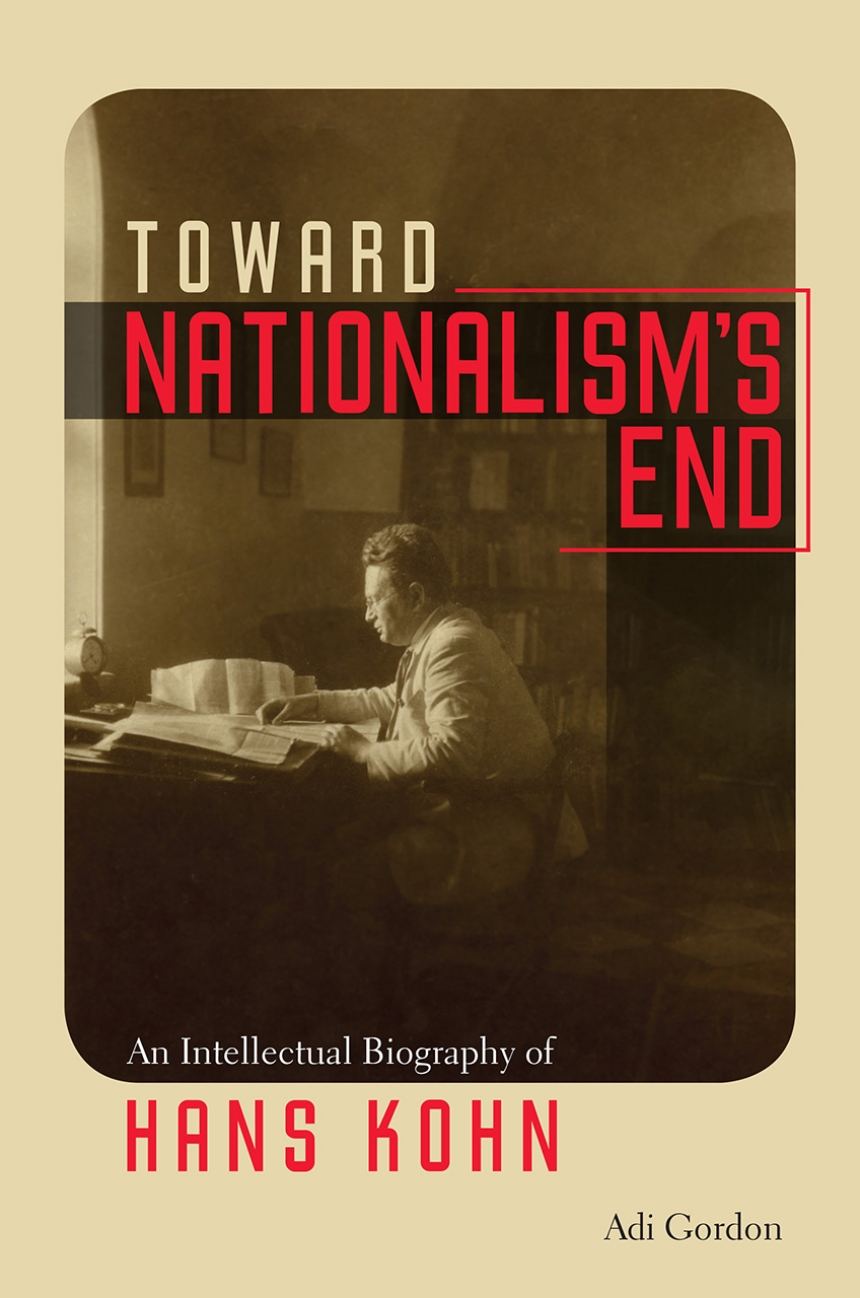
Eventually Hans Kohn was completely disillusioned, not only with Revisionist Zionism but also with the failed peacemakers of Brit Shalom and Ihud. I would like to use a bit of this text to shed light on Kohn’s journey for any Zionists on the edge of Zionism, with the hope that his journey may echo the feeling of fringe Zionists today. Kohn was a committed Zionist and an early settler, arriving in Palestine in 1925 and working for Keren Hayesod (the Foundation Fund of the Zionist Organisation). His worldview was changing slowly and began with a hope for a reform of Zionism. Following the 1929 riots, or the Buraq Uprising, he hoped this crisis would force the Zionist movement to transform itself. He wrote this to Judah Magnes in 1929:
I am afraid the Zionist movement will again go the wrong way, the way all governments and nations would go... I am afraid that our friends do not understand the true situation: we are faced by the “national revolution” of an oppressed people. The Arab mob is fighting for a nation, or a nationalistic idea-ideal, just as our people, or the Sinn Fein did. And there are only two ways left now: either to oppress the Arabs and to keep them down by a permanent display of strong military force, a colonial and imperial militarism of the worst sort—or Zionism must ultimately discover its true face, which has nothing to do with state, majority, or political power..... We all ought to... do all we can to find a way to the Arabs and to change entirely the face of Zionism in light of pacifism, anti-imperialism, democracy—and this means the spirit of true Judaism. Now we have to show all the cleanliness [sic! i.e., purity] of our thinking, to remain objective, impartial, not to become subject to herd instincts.
Our great hour has come! I should like to act together. I never was as excited as now I feel it goes to the root of all my human consciousness. If we waver only a little, I feel true Zionism is lost!11
This quickly followed by (forced) resignation from Keren Hayesod and an abandonment of Zionism. This decision was the result of long personal and moral reflection; but also pressured by external factors. Kohn had “inconceivable incitement against” him due to his outspoken criticism of the iron fist policy in Palestine. He wrote in his diary that “if people here were empowered, they would have tried me for treason”.12 He detailed the motivation to leave the Zionist organization and minced no words about Zionism.
Lately, I have become increasingly aware that the official policy of the Zionist Organization and the opinion of the vast majority of Zionists are quite incompatible with my own convictions. I, therefore, feel that I can no longer remain a leading official within the Zionist Organization. The Zionism that I have championed since 1909 was at no time political. I and a group of my friends regarded Zionism as a moral-cum-spiritual movement within which we could realize our most fundamental humane convictions: our pacifism, liberalism, and humanism. [...] Zion was to be the place where we would be able to realize our humanitarian aspirations.
The reality of the Zionist movement and of Jewish settlement in Palestine is far from all this. You know that for years I have been fighting the battle for those ideas which to me represented the very meaning of Zionism. Eventually these ideas acquired focus in the so-called Arab question. For me, this question became the [moral] touchstone of Zionism. This conclusion was, however, not prompted by any particular sympathy for the Arabs or excessive appreciation of their merits. I was concerned not with the Arabs but with the Jews, their Jewishness and the confirmation of their humane [values]. It has, alas, become increasingly clear to me that, in this respect, the Zionist Organization has failed utterly. The decisive experience was the Arab national uprising in August 1929...
We pretended to be innocent victims. ... But we are obliged to look into the deeper cause of this revolt.... The Arab national movement is growing and will continue to grow. In a short time it will be much more difficult for us to reach an agreement than it is today. Increasing our numbers by tens of thousands will not make it any easier. I believe that it will be possible for us to hold Palestine and continue to grow for a long time. This will be done first with British aid and later with the help of our own bayonets—shamefully called Haganah [i.e., defense]—... but by that time we will not be able to do without the bayonets. The means will have determined our goal. Jewish Palestine will no longer have anything of that Zion for which I once put myself on the line.13
One year later he cut ties with Brit Shalom too. This marked the complete loss of faith in Zionism. He lost all faith in Brit Shalom’s lacklustre methods of achieving peace and ideologically shifted away from the binational vision. He objected completely to the idea of creating a Jewish majority in Palestine, whereas Brit Shalom saw no issue in that step. This is a man that was ahead of his time and was lost to history. I hope by shortly telling his story, he can inspire the new generation of Zionists to see the shortfalls of Zionism, if not from a humanist perspective, then as an unsustainable national movement for Jews.
When I began writing this text years ago, I was a nationalist, I was a Palestinian nationalist. Now I understand that nationalism is misguided. As Basel Al-Araj would put it, there is one binary in this world, and one binary in this conflict: the oppressed and the oppressor. If you are not with the oppressed, you are aiding the oppressor. There is no Jew and Palestinian, there is only the oppressed and the oppressor. Many Palestinians have played the role of oppressor on Palestinians, and many Jews today are outwardly and bravely with the oppressed. The only path towards solution begins by abandoning political nationalism. When I refer to nationalism, I do not speak of patriotism and a love and respect for one’s own culture and ancestry. Instead, I speak of the state of mind in which the individual’s loyalty above all is a blind loyalty to one’s own (arbitrary) nation state. I speak of the invented political doctrine of nationalism. Nationalism, as opposed to patriotism, can quickly evolve into a belief of superiority of one’s own nation. Superiority of your own ‘natural’ nation quickly evolves into hatred of other nations. Hatred alone cannot draw up a programme, as put by Frantz Fanon.
Understanding Zionism is a mixture of many things. It must involve a sympathy towards the plight of the Jews of Europe, with an understanding that they planned to solve their problems with no regard as to the consequences it would have on us. It must involve a compartmentalisation between that face value idea, and the brutality required to implement it, but without separation of the ideology and the crimes committed to achieve it. It was colonisation with moral backing, but colonisation, nonetheless. There must be an understanding that it is different to any other form of colonisation, in which the native population is known to exist and sought to be exploited as a labour class. Contrary to that, Zionism is a form of colonisation that is threatened by the existence of a native population and must hence resort to aggression to rid that threat. Then it becomes entangled in more complexity when the ever-overlooked situation of the Mizrahi Jews is considered. It cannot be omitted that Zionism is also firstly a Jewish national movement. Thus, it is important not to fall into the trap of boxing in Zionism into simpler concepts as analogies; there is nothing analogous to this ideology, all that has happened in its name, and all that has happened in battling it. Palestine in my eyes is the current acme at which nationalism, human rights, freedom and self-determination can be studied, because (as Edward Said put it) it cannot be made simple. It is only under this lens that the Palestinian identity can then be understood. It is only under this lens that I can begin to explain to you my Palestinian identity, but that is for another text.
References
- Theodor Herzl, The Jewish State (1896). ↩
- Leon Pinsker, Auto-Emancipation (1882). ↩
- Leon Pinsker, Auto-Emancipation (1882). ↩
- Leon Pinsker, Auto-Emancipation (1882). ↩
- Arthur Ruppin, letter to Hans Kohn (1928). In Arthur Ruppin: Memoirs, Diaries, Letters (1896–1919): Early Years of the Palestine Office. ↩
- Arthur Ruppin, memoir (1928). In Arthur Ruppin: Memoirs, Diaries, Letters (1896–1919): Early Years of the Palestine Office. ↩
- Hans Kohn’s diary, 8 September 1929, HKC, box 18, folder 4. Quoted in Adi Gordon, “‘Nothing but a Disillusioned Love’: Hans Kohn’s Break with the Zionist Movement,” in Ezra Mendelsohn, Stefan Hoffman and Richard I. Cohen (eds.), Against the Grain: Jewish Intellectuals in Hard Times, chapter 8. ↩
- Ze’ev Jabotinsky, The Iron Wall (1923). ↩
- Ze’ev Jabotinsky, The Iron Wall (1923). ↩
- Hans Kohn, letter to Robert Weltsch, 21 April 1930, reel I. Quoted in Adi Gordon, “‘Nothing but a Disillusioned Love’: Hans Kohn’s Break with the Zionist Movement,” in Ezra Mendelsohn, Stefan Hoffman and Richard I. Cohen (eds.), Against the Grain: Jewish Intellectuals in Hard Times, chapter 8. ↩
- Hans Kohn, letter to Judah L. Magnes, 2 September 1929, Central Archives for the History of the Jewish People (CAHJP), Jerusalem, P3/2665. Quoted in Adi Gordon, “‘Nothing but a Disillusioned Love’: Hans Kohn’s Break with the Zionist Movement,” in Ezra Mendelsohn, Stefan Hoffman and Richard I. Cohen (eds.), Against the Grain: Jewish Intellectuals in Hard Times, chapter 8. ↩
- Hans Kohn’s diary, 17 October 1929, HKC, box 18, folder 4. Kohn relates here to a parallel (though lesser) assault against Hugo Bergmann following his article “The Event in Jerusalem,” on the front cover of the Prager Tagblatt of 28 August 1929. Quoted in Adi Gordon, “‘Nothing but a Disillusioned Love’: Hans Kohn’s Break with the Zionist Movement,” in Ezra Mendelsohn, Stefan Hoffman and Richard I. Cohen (eds.), Against the Grain: Jewish Intellectuals in Hard Times, chapter 8. ↩
- Hans Kohn, letter of resignation from the Zionist Organization. Quoted in Adi Gordon, “‘Nothing but a Disillusioned Love’: Hans Kohn’s Break with the Zionist Movement,” in Ezra Mendelsohn, Stefan Hoffman and Richard I. Cohen (eds.), Against the Grain: Jewish Intellectuals in Hard Times, chapter 8. ↩

Click the picture to return home.