

This piece is part 1 of a 4 part series titled Useless Humanities
A Waste of Money and Labour
Technology is developing rapidly, science is uncovering cosmic secrets every week, and corporations are making more profits than entire countries’ GDPs. In a world obsessed with practicality, productivity, and shareholder value, the humanities seem to offer little more than pretentious prose in piles of paper (and alliteration). An engineer building a bridge seems much more valuable to society than a philosopher talking about “we should build bridges, not walls.” But society is not merely neutral toward the humanities, but has come to resent them.
Do you really need my money for your silly hobby?
People would let the humanities be and go on doing useful things. But the problem is that the humanities takes their money. When people see thousands of dollars of public funds pouring into humanities departments, they can’t help but wonder if their tax money could be better spent on schools, hospitals, or even state-run, public shawarma stands. Here are some angry comments from real people on the street (that I completely made up) expressing their concern with the government spending too much on humanities programmes:
“My neighbour’s daughter’s wife’s cousin knows a guy who knows another guy working at the gas station in the next town whose sister won the lottery. I’m so jealous. Anyways, my neighbour herself is on her twelfth year of a PhD focusing on the history of Medieval cookbooks. I’m sure their avocado toasts slapped, but I don’t want my tax money to fund someone’s midnight cravings. Just get an avocado toast with an affogato, for god’s sake.”
“I dated a lit major writing a dissertation on James Joyce’s Finnegan’s Wake. If you want to share your thoughts on a book, join a book club. Who cares about a guy named Finnegan, much less whether he wakes up or not? I’ve never even met a single Finnegan in my entire life.”
“I’m but a mere plumber; yet, I do acknowledge the preponderance of the arts and humanities in bringing catharsis to the human experience. One must, however, acquiesce the frivolity of a particular genus of scholastic endeavours within such disciplines. What could be, pray tell, the significance of determining the difference between Michelangelo and Da Vinci’s varnishing techniques? In this mise en scène of wealth inequality, social injustice, and government overreach, there are more pressing contentions than the utility of Russian formalism versus psychoanalysis in literary critique. When a pipe bursts, I fix it, and the government gave me no stipend during my training. I myself love to indulge in the arts, philosophy, and literature. But I do it in my free time and find interlocutors to share my musings with at book club meetings and podcasts. My insights reach thousands of people who benefit from them. But I don’t think our taxes should be spent on the pedantic sorts of things going on in humanities departments when they could be more wisely spent on public goods and services.”
While your average tech or finance bro might see any minute spent on anything but increasing shareholder value as a waste of time, most people do recognise the value of art and humanities. People understand that literacy is important. Modern Arab women, for instance, champion Latifa al-Zayyat’s novel The Open Door (Al-Bab al-Maftouḥ) as a conduit for expressing their struggles in patriarchal society and emphasising the urgency of fighting back on both a collective and individual level. People appreciate the value of art. Modern Europeans, for example, can see how William Hogarth’s painting The Marriage Settlement is still relevant in its critique of transactional marriage, especially today when we like to believe that we get married for love.
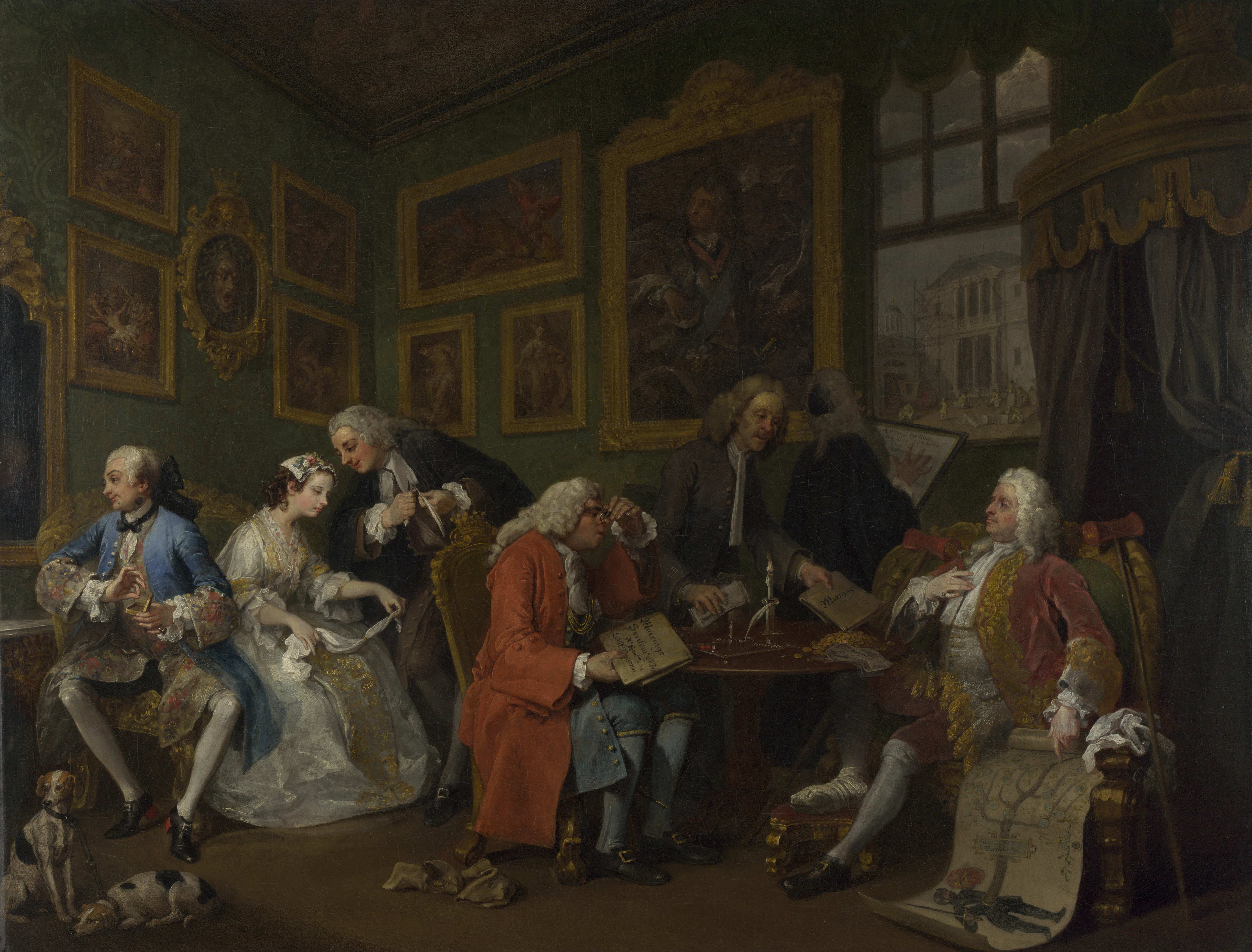
People’s problem with the humanities on a societal level is that they drain public resources. People understand their importance, but prefer that individuals pursue their interests in the humanities on their own time and dime, after a productive day at a “real” job, without using public funds, and to have the generosity to teach what they know for a reasonable fee to whomever wishes to learn, or share them for free online. My problem is that other fields are not treated so horribly. Although STEM (science, technology, engineering, mathematics) research and academia are not treated much better, society still understands that at least some public funds need to be poured into labs if it wishes to see a cure for cancer or those damn flying cars one day. Many even understand that the cost of scientific advancement is a lot of dead ends.
I’d rather have a bridge than a painting of one
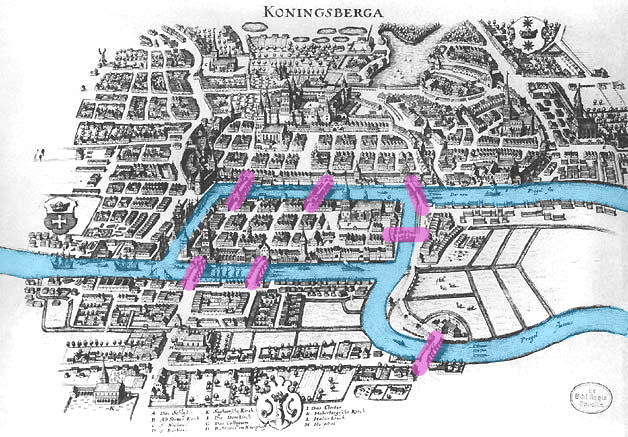
"The seven bridges of Königsberg” is an old math puzzle seen as trivial by serious mathematicians until its solution became the foundation for flight patterns and satellite navigation. The Prussian city of Königsberg was divided in half by a river within which two small islands lay. A puzzle went around asking whether or not one can visit each part of the city without crossing any bridge more than once. (Go ahead, try to solve the puzzle shown in the picture above!) in 1735, the Swiss mathematician Leonhard Euler solved the puzzle. I won’t bore you with the mathematical details. You wouldn’t understand anyway, you’re a humanities major. But the solution has something to do with odd and even numbers and Euler mathematically proved that the puzzle has no valid solution, developing Graph Theory to do so. At the time, his findings had no practical use (other than disappointing Königsbergians awaiting a solution to their local puzzle), but centuries later, Graph Theory is the foundation of things we depend on everyday such as GPS navigation, commercial flight management, and data routing. Most people understand that scientific development thrives when scientists are allowed to follow their curiosity even when it leads to a dead end and that they might not find immediate practical use for their discoveries. Every dead end teaches us what not to do next time and a discovery that seems purely theoretical today might drive technological development tomorrow.
This attitude is not afforded to the humanities, though. That’s because the humanities benefit completely different aspects of our lives than STEM fields and it’s not as easy to recognize. People wonder, “Can a philosopher build a bridge? Can a historian figure out time travel and finally show us what the whole deal is with the Library of Alexandria (I’m still pissed about it)? Can an ethnographer invent those damn flying cars we’ve been asking for?” People deem things useful when they can see them with their own eyes and benefit from them directly. They’d rather have a bridge in their city, than a pretty painting of one, or worse yet, an art history paper about a painting of a bridge. They’d even rather have a mathematician develop a foundational theory while puzzling over bridges.
Capitalism! It’s always capitalism’s fault
I’ve talked about how the general public are dismayed with the humanities only because it uses up public funds. But the capitalists running the world have more sinister reasons for their resentment of the humanities. Our world is deeply capitalist and it insists that value must be material, visible, tangible, clear, and immediate. That’s because capitalism is a system designed by capitalists to generate profit for themselves, mostly by exploiting workers and resources. So, for them to deem anything valuable, it must return immediate profits for them. STEM fields, especially the STE part, earn the blessings of capitalists because they can be exploited to generate profits through industries like healthcare, technology, and construction.
The humanities, however, do not generate much material profit for capitalists, but rather provide intellectual, emotional, social, and spiritual capital for human beings. It’s in the name; HUMANities. That’s why capitalists are heavy on the idea that the humanities should be at best considered a collection of pretty little hobbies and fun facts to be engaged with in your leisure time and the amount of money that goes into funding them should be kept at a minimum or even completely cut. But capitalists do not despise the humanities simply because they don’t turn a profit, but because the humanities can stand in the way of enriching the already rich and awaken the proletariat to their exploitation.
A lot of things we take for granted in the modern world come from the humanities. Democracy, human rights, and social justice are not the products of chemistry or mathematics. The humanities played a big role in the social movements of the last century that fought against capitalist exploitation and improved people’s lives. Feminism, a branch of the humanities, freed women from financial dependence and gave them the right to earn and keep their own money. Leaders of the American Civil Rights Movement, Dr Martin Luther King Jr and Malcolm X, cited philosophers from Plato to Hagel to make their arguments about the equality of all human beings, and they themselves are cited in humanities papers today. Humanities graduates are the ones writing books today about the genocide in Palestine and Sudan and all around the world.
Indeed, medicine, construction, and technology are all very important for a healthy and functioning society, but these only lay the basic foundations upon which a dignified life can be built. What’s the point of building a residential area if you can’t build a healthy community of people to live there? What’s the point of medicine extending human life if we just live more years in misery? What’s the point of technology making our lives more convenient if it also distracts us from finding purpose and meaning?
An engineer builds us a bridge, but painter shows you how it destroys the migrant neighbourhood (tune in to part II where I discuss such a painting). A physicist discovers new uses for nuclear energy, but the historian tells you how that will be used to make bigger bombs. A psychiatrist prescribes medication for depression, but that’s not enough. Apart from medication, you need community and purpose in life for good mental health, and the philosopher can show you how. It is the anthropologist who warns you that the politician you’re about to vote for will deport you first before anyone else. The philologist shows you how the elites manipulate cultural narratives to suppress the voices of the oppressed. The classicist shows you how the myths of the past are used to hide the tyranny of today. Giant corporations build energy plants, but the ethnographer shows you how the new dam will end the livelihood of the indigenous tribe living downstream.
In this part, I aimed to articulate society’s dismay with the humanities and its misunderstanding of them. I also touched upon why capitalism insists on the uselessness of the humanities in a world that runs on money and profit. In the following parts, I’ll go deeper into capitalist propaganda against the humanities and give you detailed examples of how greatly the humanities benefit society and why they should be funded as well as touch upon the arts and their benefits for society and the individual. As for your expensive humanities degree keeping you unemployable, I have some thoughts about how it can be leveraged to build a dignified life and perhaps make a decent living.