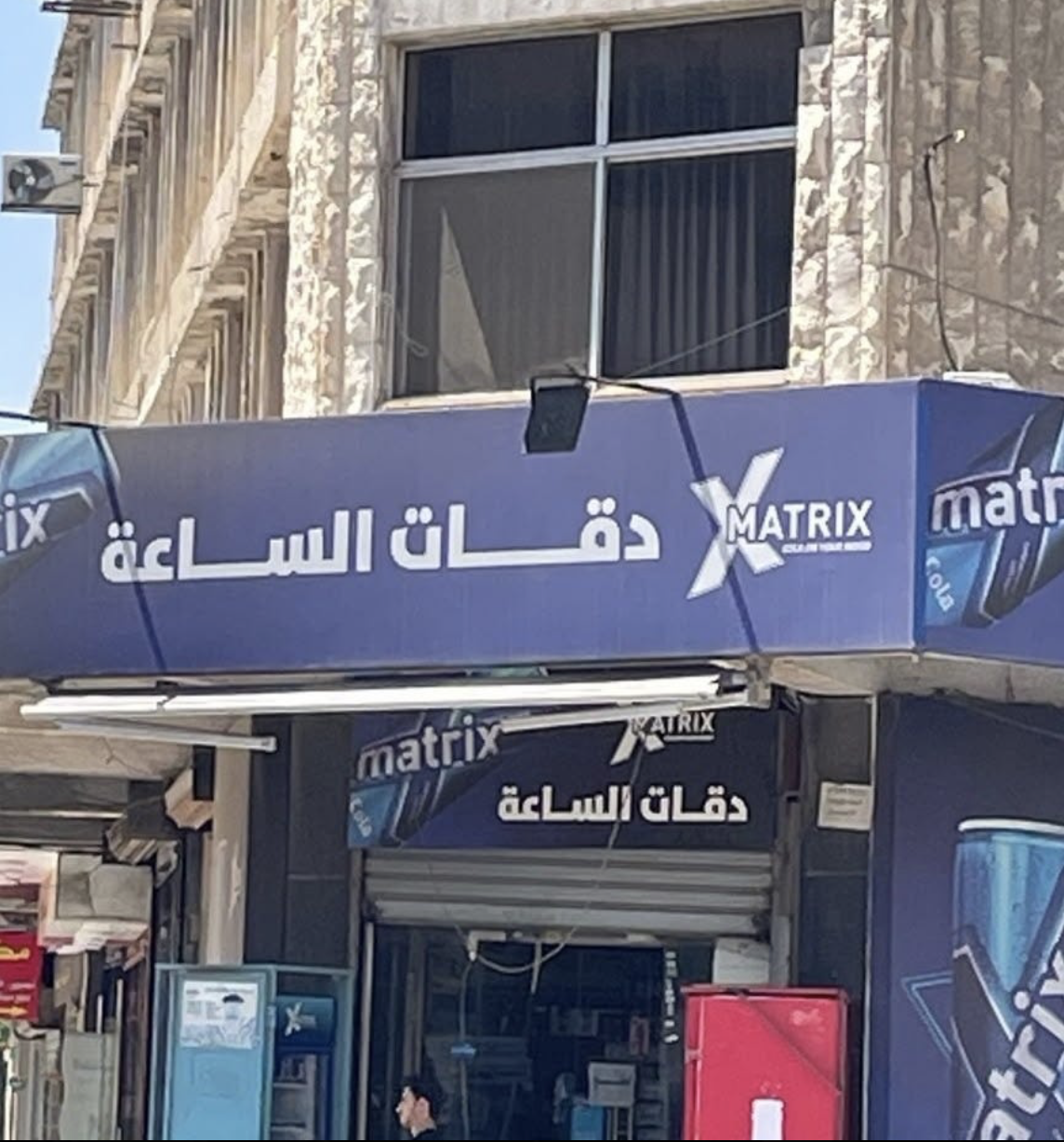
On Tuesday, July 21st, walking through Jabal Al Hussein toward Gamal Abdelnasser roundabout, I needed a refreshment to cut through a 35-degree afternoon. As I climbed the steps, the sign read “Daqat Al Sa’aa” (دقات الساعة), meaning the ticking of the clocks. It was rendered, like half the shopfronts on the street, in that familiar Matrix Cola-blue script that tells you it’s a supermarket before you’ve read a word of the name itself. It got me thinking about the name itself. I’ve spent enough time abroad to notice how differently Amman does this; its shop names are specific, unpolished, sometimes outright random, in a way that most cities aren’t. A name like “Daqat Al Sa’aa” sticks with you in a way a name like “Spinneys” never will, because Spinneys was built by a brand team to be memory-safe, and this one clearly wasn’t constructed by anyone. It just happened.
When opening up a business, the owner is charged by what appeals to the masses, what makes their own business, whether be it service or brick and mortar stand out to the rest of the competition. I know what you might think, for a piece that referenced “Daqat Al Sa’a” as a real-life example of a business name, how does that exactly stand out in a way to promote a business?
First thing to note, in Amman, culture and day-to-day aspects of our lives are intertwined. Culture has an indirect influence over what you eat, drink and how you act as an individual.
Take, for example, a restaurant called Al Dar Darak (الدار دارك, meaning the house is yours) in Tabarbour. If you’ve grown up in Amman, the phrase needs no explanation, it’s what you say without thinking when someone in your house asks permission for something. Can I use the bathroom? Al dar darak. Can I get a glass of water? Al dar darak. It’s less an answer than a reflex, the verbal equivalent of waving someone further inside. I never asked the owner why he chose it, and I don’t think I need to, every Ammani has said that phrase a thousand times without registering it as anything more than politeness.
To put it on a signboard is to take something so mundane it’s practically invisible and hand it back to the street as an identity.
This is where the distinction starts to matter. A name like Al Dar Darak isn’t telling you what the restaurant sells or what tier of experience to expect, the way a Western-style name might. It’s making a claim about the relationship you’re about to have with the place, you’re not a customer here, you’re a guest, and the sign has already welcomed you in before you’ve opened the door. That’s a kind of branding a franchise consultant would never approve, because it doesn’t scale. You couldn’t lift “Al Dar Darak” and open the same restaurant under the same name in London, it would mean nothing there. It only works here, said by people who live here, to people who already feel the phrase before they’ve finished reading it.
And this is where Amman’s storefronts are starting to change. Walk down any street that’s seen new investment (or gentrification) in the last few years, Abdoun, Swefieh and the newer stretches of Rainbow Street, and you’ll notice the names start to sound different. Cleaner. Shorter. Almost always in English, even when the business has nothing to do with anywhere English-speaking. Take Deja Brew, a coffee house in Abdoun, a pun on “déjà vu,” clever in the way that global coffee-shop names are clever, engineered for a laugh of recognition rather than a shared memory. It’s a good name. It’s also a name that could exist, unchanged, in London or Toronto or Melbourne, because the joke it’s built on has nothing to do with Amman at all, it’s a joke about the English language, borrowed wholesale and dropped onto a street in Abdoun.
There’s nothing wrong with that name on its own. But set next to Al Dar Darak, the contrast is hard to miss. Al Dar Darak is written for someone who already lives here, someone who feels the phrase before they’ve finished reading it, because they’ve said it themselves a thousand times. Deja Brew is written for no one in particular…
or rather, for an audience that could be anywhere, because increasingly, that’s who these businesses are trying to appeal to.
This isn’t a coincidence. It tracks with a broader shift in what counts as aspirational in Amman right now, a kind of business fluency that treats “sounding international” as a proxy for quality, and treats “sounding local” as something to grow out of. A shop that used to be named after the owner’s daughter, or a phrase their grandmother used to say, gets rebranded with something sleeker when it moves from a family stall to an actual storefront, as if the old name were a starter home to be sold off once you could afford better. And maybe that impulse is understandable, global branding conventions exist because they work, because there’s real commercial pressure to look “professional,” to look like you belong on the same street as the international franchises moving in next door. But something gets lost in that trade. A name like “Daqat Al Sa’aa” or “Al Dar Darak” couldn’t have come out of a strategy meeting. They’re not aspirational, they’re observational. Someone looked at their own life, or their own city, and named the business after what they actually saw or said. Deja Brew isn’t observing anything about Amman.
It’s auditioning for a city that isn’t Amman at all.
I keep thinking about that walk. The heat, the steps up to a supermarket that ticks like a clock, a restaurant down the road that’s already opened its door for you before you’ve knocked. Amman is a city you can read block by block if you slow down enough to look up. Every signboard is a small, unintentional archive, a grandmother’s phrase, a private joke, a moment someone thought was too ordinary to matter, preserved in lettering above a doorway. You don’t need a translation to feel most of them. You just need to have lived here long enough to recognize your own life reflected back at you from a shopfront you didn’t design and never asked to be a mirror.
I wonder how much longer that will be true. Every Deja Brew that opens is a perfectly reasonable business decision, and at the same time, one less name that could only have come from here, one less joke that only your Teta would get, one less phrase that gives away, instantly, that you’re home. Maybe that’s just what growth looks like. But I think about the kid growing up in Amman ten years from now, walking the same streets I did, looking up at storefronts that could just as easily be in any other city, and I wonder what he’s supposed to feel when he looks up.
Recognition, or nothing at all?
Click the picture to return home.